
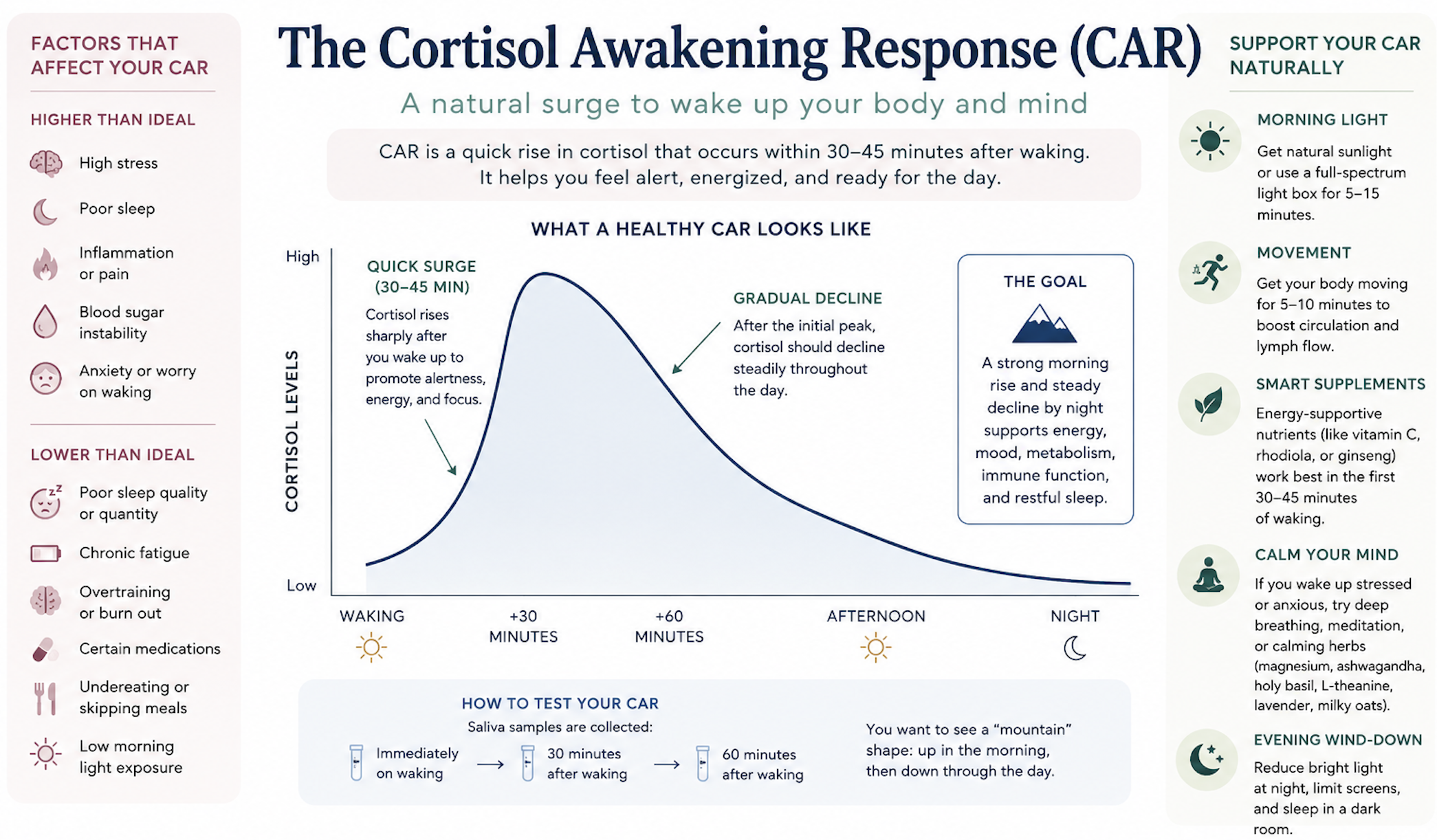
How Do You Feel On Waking: Understanding The CAR
When you wake up in the morning, how long does it take you to go from conscious to alert? Ideally, you answered 30 to 45 minutes. This is a biological process known as the cortisol awakening response (CAR). It's a natural rise in cortisol that occurs after waking to help you become alert, energized, and ready for the day. Researchers think this response developed as a survival mechanism. Thousands of years ago, when our ancestors woke up, they had no idea what the day would bring. Would there be food? Would there be danger? Would they have to run, hunt, or defend themselves? A healthy cortisol awakening response prepared the body for whatever came next. Today, we often use CAR as a marker of how your brain and body are anticipating the day ahead. If you found yourself thinking,"It takes me two hours and two cups of coffee before I feel awake." or "I wake up at a level 10 with anxiety" then I immediately start thinking about your cortisol awakening response. One of my favorite clues as a clinician is when someone starts a sentence with:

Top Herbs for Fatigue and Low Cortisol
Fatigue can be due to a million reasons. Maybe it’s stress. Maybe it’s low thyroid. Maybe it’s low iron. Maybe you’re not sleeping that well. Whatever it is while you’re working on the cause, certain herbs may be helpful based on their long history of use. A common reason for fatigue is low cortisol production. I’m not talking about the autoimmune condition known as Addison’s disease where your adrenal glands can’t make enough cortisol. I’m talking about the fatigue that comes with long term stress, inflammation, illness, infection, etc. It can take its toll on the body and be downright exhausting…

Fatigue, Weakness & Depression? Might Be Low B12
Vitamin B12 (Cobalamin) is an essential water-soluble vitamin that plays a HUGE role in your nervous system, red blood cell formation, DNA synthesis, detoxification, ATP production and more! Depending on the literature, 6-15% of people under the age of 60 and 20% or more over the age of 60 are deficient! This is concerning as the symptoms are so common and often blown off yet the treatment is so simple! If you have low B12, you’re likely to experience: Fatigue or weakness, Shortness of breath. Numbness or tingling in your hands and/or feet. Balance problems (maybe difficulty walking or shuffling), Memory loss, confusion or cognitive issues, Depression...